 Maldives Compass
How the Atolls Formed
The geological history of the Maldivian atolls.
Every Maldivian island was made by living coral - here is how reef, sand, and ocean work together to create land.
Unlike most islands in the world, which are formed by volcanic eruption, tectonic uplift, or erosion of continental landmasses, Maldivian islands are built entirely by biological processes. Every grain of sand on every beach was once part of a living organism - a coral colony, a mollusc shell, a calcareous alga, or a tiny creature called a foraminifera. The process of island building begins underwater, on the coral reef, and takes centuries to millennia to produce dry land.
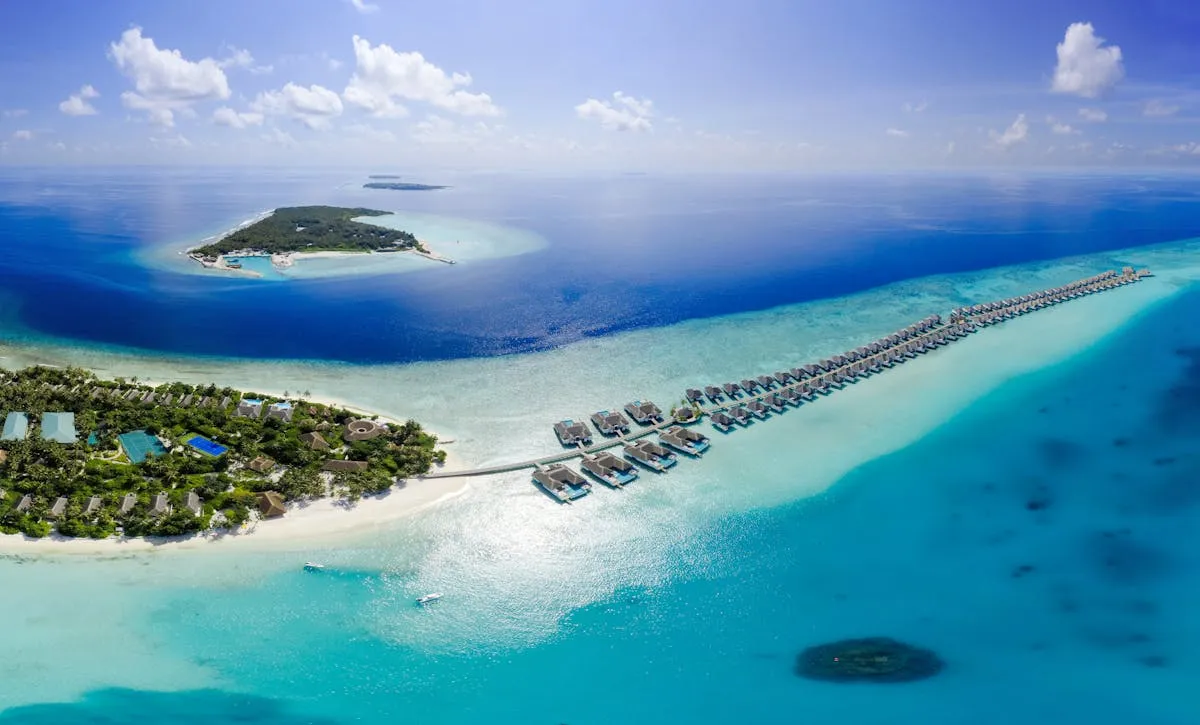
Understanding this process transforms the way you see the Maldives. The sand beneath your feet is not inert geology - it is the accumulated remains of millions of marine organisms, ground down by waves and deposited by currents into the formations we recognise as islands.
Every island sits on a reef platform. This platform is a structure of solid coral limestone, built up over thousands of years by generations of coral polyps secreting calcium carbonate skeletons. The reef platform grows horizontally and vertically, but it can only grow upward to approximately the low-tide level, because coral needs to be submerged in seawater to survive. This imposes a natural ceiling on how high the reef can build itself.
The reef platform provides the foundation onto which loose sediment accumulates. Without the reef, there would be no stable surface for sand to collect - the ocean currents would simply carry it away. The shape and orientation of the reef platform determines where islands can form, which is why islands typically appear on the rims of atolls and faros (mini-atolls within the larger atoll) where the reef is widest and most exposed to wave energy.
The sand that forms Maldivian islands comes from several biological sources. The largest contributor is coral itself - when waves, storms, and boring organisms break coral colonies into fragments, these pieces are gradually ground into smaller and smaller particles by continued wave action. The resulting sand is brilliantly white because coral skeletons are made of calcium carbonate, a naturally white mineral.
Other significant sand producers include:
Sand production alone does not create an island. The sand must be transported and deposited above the high-tide line to form dry land. This is primarily the work of waves and currents. On the reef platform, waves pick up loose sediment and carry it toward the centre or leeward side of the reef, where energy decreases and the sand settles. Over time, a ridge of sand accumulates above the water level.
Storm events play a surprisingly important role. Large waves generated by tropical storms can throw coral rubble and coarse sand well above the normal high-tide mark, building ridges that persist long after the storm has passed. These storm deposits often form the highest points on Maldivian islands, typically just one to two metres above mean sea level. Between storms, calmer wave action fills in the gaps with finer sand, gradually smoothing and expanding the island.
Once a sand deposit rises above the high-tide line and remains dry long enough, pioneering plants begin to colonise it. Salt-tolerant grasses and creeping vines are usually the first to arrive, their seeds carried by wind, waves, or birds. As vegetation takes root, it stabilises the sand with its root network, preventing wind and wave erosion from washing the new island away.
Coconut palms, which are iconic to the Maldives, play a crucial role in later stages of island development. Their extensive root systems bind the soil, their falling leaves create organic matter that enriches the sandy ground, and their tall canopies reduce wind speed at ground level. Over centuries, a mature island develops a thin layer of soil, a freshwater lens floating on the saltwater beneath, and a self-sustaining vegetation community. This is the process that has created every naturally occurring island in the Maldives, from the smallest sandbank to the largest inhabited island.
Maldivian islands are not static. They shift, grow, shrink, and change shape over time in response to changing wave patterns, sea levels, and sediment supply. Studies using satellite imagery have shown that many Maldivian islands have actually grown in total land area over recent decades, despite rising sea levels, because increased wave energy and sediment transport have deposited additional sand. Other islands have eroded significantly, particularly on their exposed windward sides.
This dynamic nature means that the Maldives you see today looks different from the Maldives of a century ago, and it will look different again in the future. The islands are living geological formations, constantly being reshaped by the same forces that created them. For a deeper look at the geological timescale, see our guide to how the atolls formed.