 Maldives Compass
The Physics of Blue Water
The intense blue and turquoise colours of the Maldives are not a trick of photography or a product of digital filters. They are the result of well-understood physics. When sunlight enters the ocean, water molecules absorb the longer wavelengths of light first. Red, orange, and yellow are absorbed within the first few metres of depth. The shorter blue wavelengths penetrate much deeper and scatter in all directions, which is why the open ocean appears deep blue to our eyes. This is known as Rayleigh scattering, the same phenomenon that makes the sky blue.
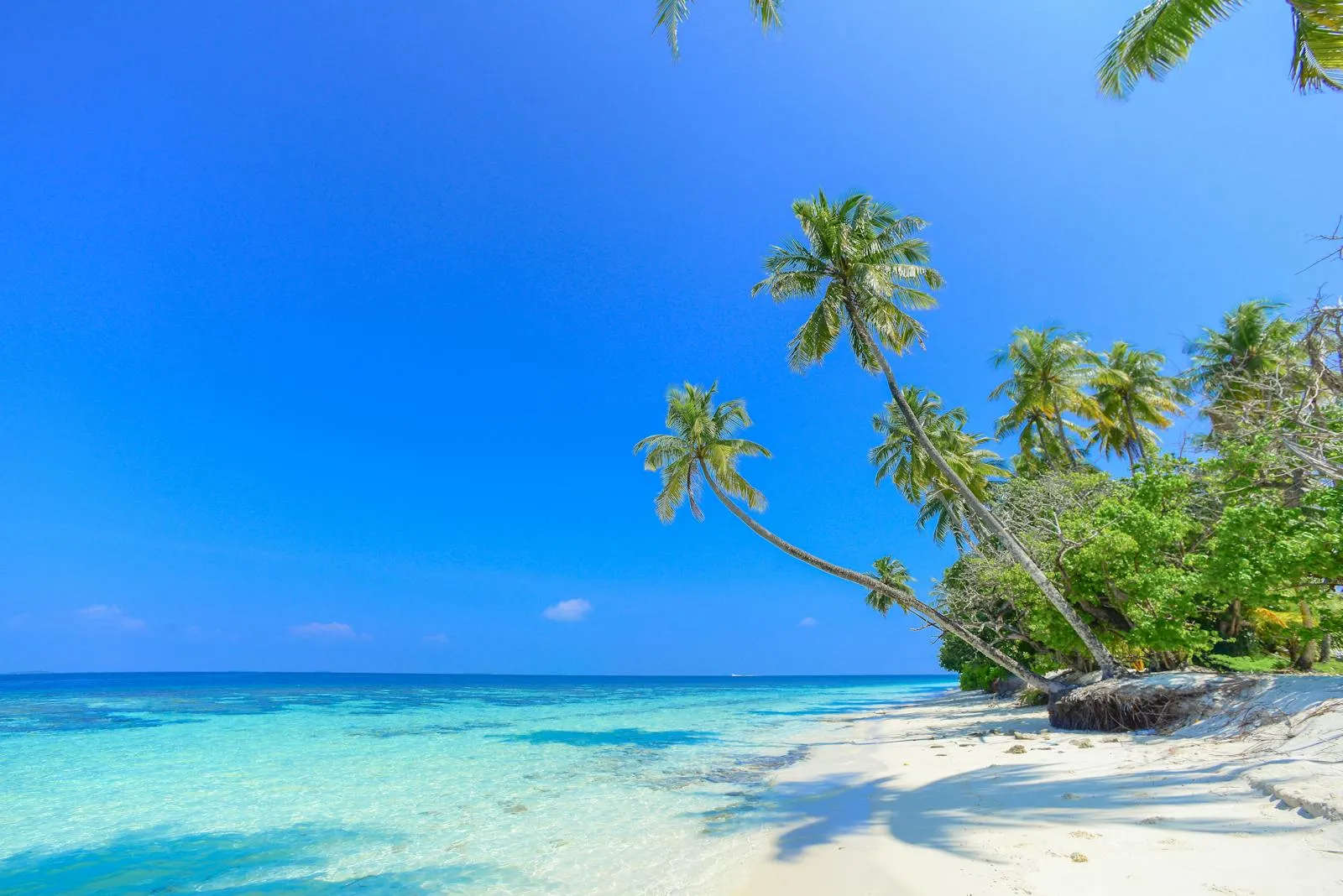
In the Maldives, this effect is amplified by several factors that work together. The tropical latitude means the sun sits high in the sky for most of the year, sending light almost vertically into the water. This maximises the amount of light entering the water column and reduces surface reflection, making the colours appear more vivid and saturated than they would at higher latitudes where the sun strikes the surface at a lower angle.
The Role of Shallow Lagoons and White Sand
While the deep ocean around the Maldives appears a rich navy blue, the shallow lagoons surrounding each island produce a completely different palette. These lagoons are typically between one and four metres deep, with floors of brilliant white coral sand. When sunlight passes through this shallow water and bounces off the white sand below, it returns to the surface carrying a vivid turquoise or aquamarine hue. The white sand acts like a reflector, sending light back through the water column and mixing the reflected colours with the scattered blue to create the iconic gradient of blues and greens that the Maldives is famous for.
The composition of this sand matters enormously. Maldivian beach sand is not made of silica like most continental beaches. It is composed almost entirely of broken coral skeletons, shell fragments, and the remains of organisms called foraminifera. This biogenic sand is exceptionally white and fine-grained, which makes it a far more effective reflector of light than darker volcanic or mineral sands found in other tropical destinations. The result is that even at a depth of several metres, the lagoon floor is clearly visible, and the water above it glows with colour.
Minimal Runoff and Low Plankton
One of the most important factors in the clarity of Maldivian water is what is absent from it. Continental coastlines receive enormous quantities of river runoff carrying sediment, nutrients, and organic matter that cloud the water and feed algal blooms. The Maldives has no rivers, no mountains to generate runoff, and no significant landmass to erode. Rainwater that falls on the islands either soaks into the thin soil or flows a few metres into the sea. There is simply no mechanism for large volumes of sediment to enter the water.
This lack of nutrient-rich runoff also keeps plankton levels relatively low in the lagoons and nearshore waters. Phytoplankton, the microscopic algae that float in seawater, are what give nutrient-rich waters their green or murky appearance. In areas with heavy runoff, such as near river deltas, the water can be so full of plankton that visibility drops to a few centimetres. In the Maldives, the nutrient-poor waters support far less plankton, which means the water remains remarkably clear. Visibility in Maldivian lagoons and reef areas often exceeds thirty metres, and on the best days can reach fifty metres or more.
How Coral Atolls Create Clear Water
The structure of the atolls themselves contributes to water clarity. Each atoll is essentially a ring of coral reef that encloses a lagoon. The outer reef acts as a natural barrier, breaking ocean swells and filtering the water that flows through channels into the lagoon interior. Coral reefs are highly effective biological filters. The countless organisms living on a healthy reef, including sponges, tunicates, bivalves, and the coral polyps themselves, actively filter seawater as they feed, removing suspended particles and organic matter.
The circulation pattern within an atoll also plays a role. Tidal flows push water through the reef channels, known locally as kandu, creating a gentle but constant exchange between the lagoon and the open ocean. This prevents stagnation and keeps the water fresh and clear. The combination of biological filtration by the reef and physical circulation by the tides creates a self-cleaning system that maintains the clarity visitors see.
Why It Varies Throughout the Day
If you spend more than a day in the Maldives, you will notice that the colour of the water changes dramatically depending on the time of day, cloud cover, and tidal state. In the early morning and late afternoon, when the sun is lower, the water appears deeper and darker. At midday under clear skies, the lagoons reach their most vivid turquoise. During overcast weather, the colours become more muted and grey-blue. Tidal changes also shift the depth of water over the sand flats, creating a constantly evolving palette. This is not a static postcard scene but a living, shifting interplay of light and water.
Understanding these factors helps explain why the Maldives consistently produces those seemingly impossible photographs of electric blue water. It is not one single cause but a convergence of tropical latitude, shallow white-sand lagoons, absence of continental runoff, low plankton levels, and the natural filtration systems of living coral reefs. Together, these factors create water that is among the clearest and most colourful on the planet.