 Maldives Compass
The Flattest Country on Earth
The Maldives holds a notable geographical distinction: it is the flattest country on the planet. The highest natural point in the entire nation sits at approximately 2.4 metres above sea level, a slight rise on the island of Villingili in Addu Atoll. To put that in perspective, a single-storey house is taller than the highest point in this country. There are no hills, no ridges, no elevated terrain of any kind. Every one of the roughly 1,200 islands in the Maldivian archipelago is essentially a thin disc of sand and coral rubble sitting barely above the waterline.
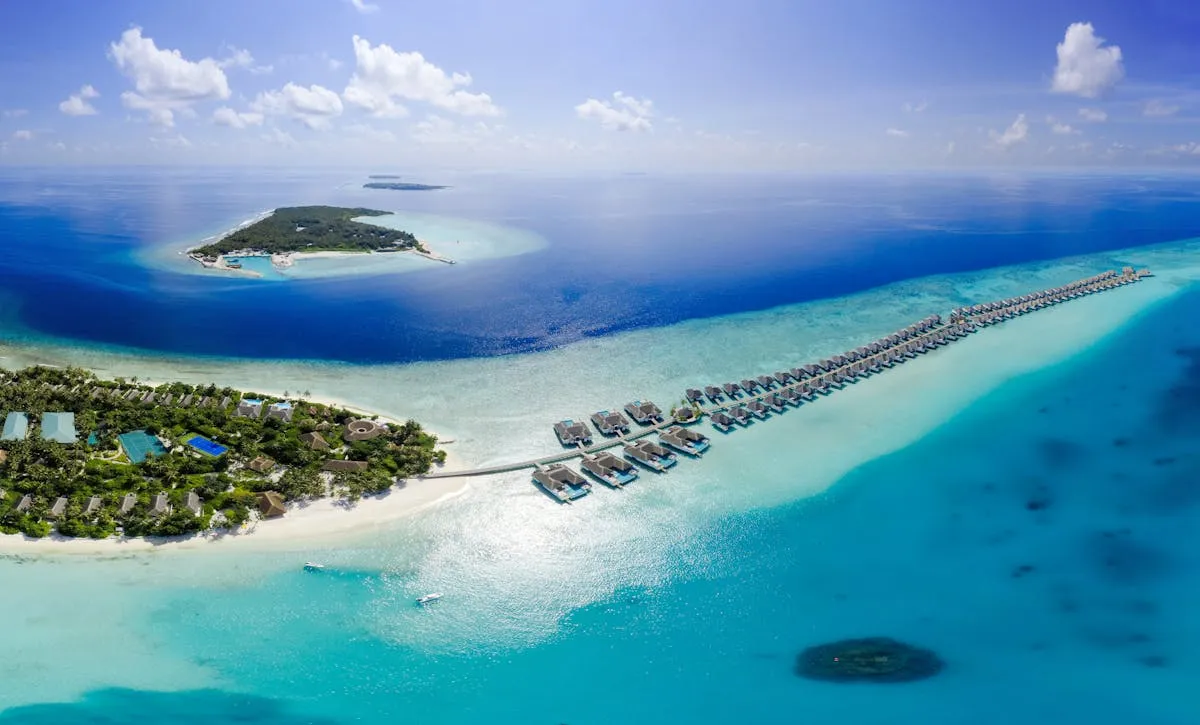
This extreme flatness is not an accident or a coincidence. It is a direct consequence of how the islands were formed. Unlike countries that have mountains, valleys, and varied topography shaped by tectonic uplift and erosion, the Maldives was built entirely by biological processes. Every grain of sand, every piece of rubble, every centimetre of elevation was produced by living coral reefs and the organisms that inhabit them. Understanding why the Maldives is flat requires understanding the coral atoll process that created it.
No Volcanic Peaks Remain
The Maldives sits on what was once a chain of volcanic mountains. Millions of years ago, volcanic activity along the Chagos-Laccadive Ridge created a series of peaks that rose above the surface of the Indian Ocean. Coral reefs grew around the bases and shores of these volcanic islands, forming fringing reefs in the warm, shallow waters. But the volcanoes were not permanent. Over geological time, the volcanic rock eroded and the underlying ocean crust cooled and subsided, causing the islands to slowly sink beneath the waves.
As the volcanic foundations sank, the coral reefs continued to grow upward, maintaining their position near the surface where sunlight could sustain them. Eventually, the volcanic rock disappeared entirely below the ocean surface, leaving only the coral structures behind. The result is what we see today: rings of coral reef, known as atolls, that enclose shallow lagoons where volcanic peaks once stood. The islands that sit on these reef rims are made entirely of coral-derived material, accumulated sand, and rubble deposited by waves and currents. There is no bedrock, no volcanic stone, nothing solid beneath the sand except more coral. This is why there is no elevation. Coral reefs grow horizontally and can only build land to a height slightly above sea level through the accumulation of storm-deposited debris.
How Coral Builds Islands
The process by which coral reefs create dry land is fascinating. Living coral grows on the reef platform, forming a hard limestone structure that can resist wave action. When storms break pieces of coral off the reef, waves carry the fragments and deposit them on the reef flat. Over centuries and millennia, these deposits accumulate into ridges of coral rubble that eventually rise above the high tide line. Wind-blown sand, broken shells, and the remains of calcareous algae add to the pile. Vegetation takes root, stabilising the sediment with root networks. The result is a small, low-lying island, rarely more than one to two metres above mean sea level at its highest point.
This process has a natural ceiling. Waves can only throw material so high, and without tectonic uplift or volcanic activity to push the land higher, the islands cannot grow beyond what wave energy and biological processes can achieve. Some coral islands in the Pacific have been tectonically uplifted, creating raised coral platforms many metres above sea level. The Maldives has experienced no such uplift, which is why every island remains at or near sea level.
Sea Level Concerns and Climate Change
The extreme flatness of the Maldives makes it one of the countries most vulnerable to rising sea levels. With no point in the country higher than about 2.4 metres, even a modest rise in sea level poses existential questions. Current projections from the Intergovernmental Panel on Climate Change suggest that global sea levels could rise by between 0.3 and 1.0 metres by the end of this century, depending on greenhouse gas emission scenarios. For the Maldives, even the lower end of these projections would mean increased flooding, coastal erosion, saltwater intrusion into freshwater lenses, and the potential loss of habitable land.
The Maldivian government has been one of the most vocal advocates on the global stage for aggressive climate action. The country has invested in coastal protection measures including sea walls, breakwaters, and beach nourishment programmes. The most ambitious project is Hulhumale, a massive land reclamation effort near Male that has created an artificial island raised to approximately two metres above sea level, designed to house a significant portion of the country's population on higher, more resilient ground.
What Flatness Means for Daily Life
Living on land that barely rises above the sea shapes every aspect of Maldivian life. There is no natural drainage, so heavy rainfall can cause temporary flooding on inhabited islands. Fresh water exists in thin underground lenses that float on top of denser seawater beneath the islands, and these lenses are easily contaminated by storm surges or over-extraction. Most inhabited islands and all resorts now rely on desalination plants for their fresh water supply.
The flatness also means there is nowhere to go during extreme weather events. When the 2004 Indian Ocean tsunami struck the Maldives, there was no high ground to flee to. The islands were simply washed over by the surge, and while the reefs absorbed some of the wave energy, the damage was extensive. The experience reinforced the vulnerability that comes with living on land that is essentially a thin veneer of sand on a coral platform in the middle of the ocean.
Despite these challenges, Maldivians have thrived on these flat islands for over two thousand years, developing ingenious adaptations to their environment. The flatness that makes the nation vulnerable also gives it some of the most beautiful beaches and accessible lagoons in the world, a duality that defines the Maldivian experience.