 Maldives Compass
What Is the Maldives
An introduction to the country.
Roughly 1,200 islands, 26 atolls, 300 square kilometres of land, and 90,000 square kilometres of ocean - the Maldives in numbers.
The Maldives is an archipelago in the Indian Ocean, lying southwest of India and Sri Lanka. It is the smallest country in Asia by both land area and population, yet its territorial waters cover a vast expanse of ocean. The contrast between the tiny land area and the enormous ocean territory is one of the defining characteristics of the nation.
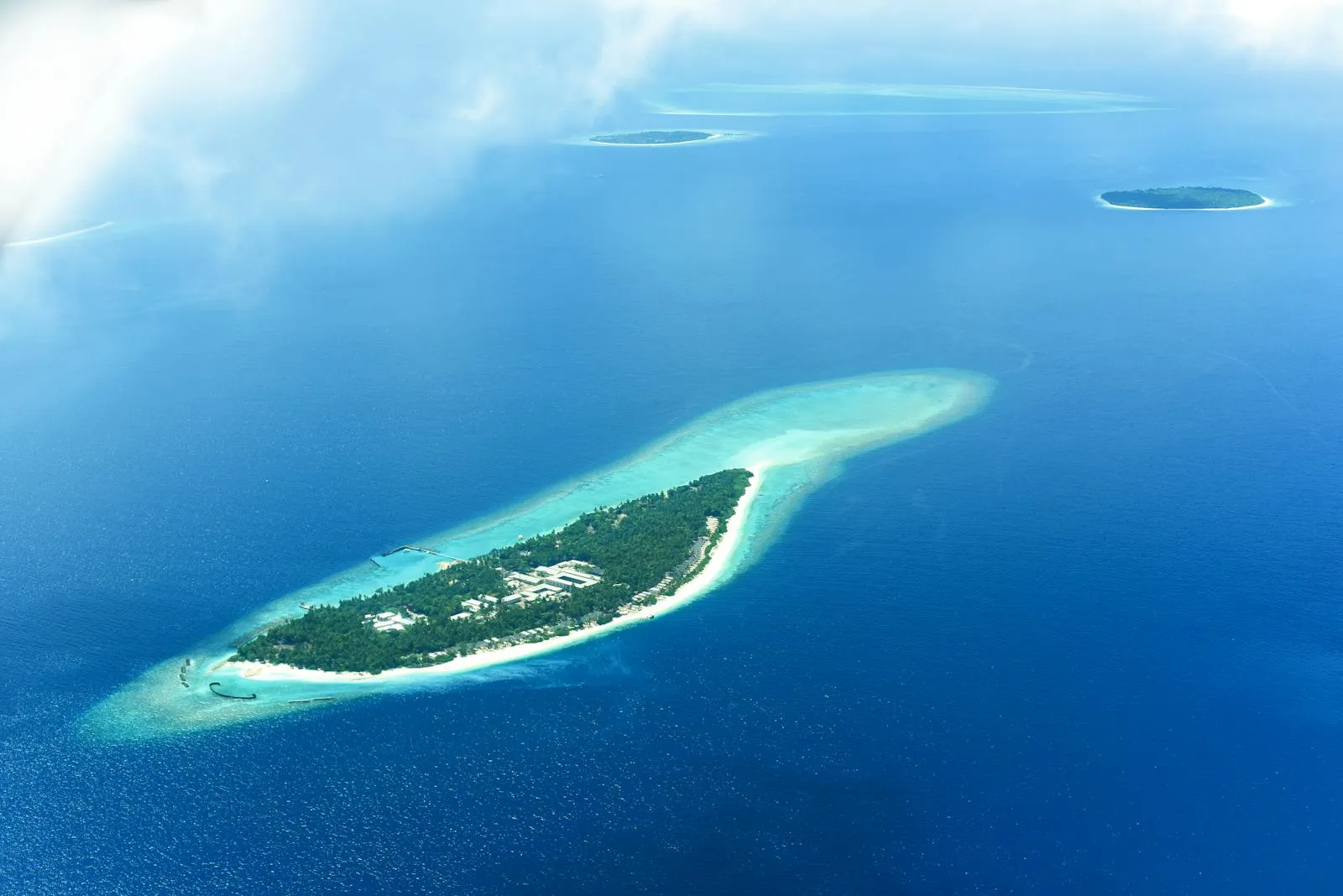
To put this in perspective: the Maldives' land area is roughly equivalent to the city of Leicester in the UK or the city of Pittsburgh in the US. Yet this tiny amount of land is spread across an ocean area larger than many European countries.
The archipelago stretches approximately 870 kilometres from north to south and about 130 kilometres at its widest east-to-west extent. It straddles the equator, with the northernmost island (Ihavandhippolhu Atoll) at about 7 degrees north latitude and the southernmost island (Addu Atoll) just south of the equator at about 0.7 degrees south.
The Maldives sits on the Chagos-Laccadive Ridge, a submarine mountain range that extends from the Indian mainland south into the central Indian Ocean. The atolls are the visible peaks of this ridge - coral structures built on volcanic foundations that sank beneath the surface millions of years ago. For more on this geological process, see how the atolls formed.
Geographically, the Maldives' nearest neighbours are India (the tip of the Indian subcontinent is about 600 kilometres to the northeast) and Sri Lanka (about 750 kilometres to the northeast). The British Indian Ocean Territory (Chagos Archipelago) lies to the south.
The 26 natural atolls are the fundamental geographic units of the Maldives. Each atoll is a ring-shaped coral structure enclosing a central lagoon, with islands scattered along its rim. Atolls range enormously in size:
Within each atoll, the islands are separated by shallow lagoons and connected by the reef platform. Deep channels (kandu) cut through the atoll rim, allowing ocean water to flow in and out of the lagoon and serving as highways for marine life - and for the boats that connect island communities.
Maldivian islands are small by any standard. The vast majority are less than one square kilometre in area, and many are just a few hundred metres across. A typical inhabited island might measure 500 metres long and 200 metres wide - small enough to walk across in 15 minutes. See living on small islands for what daily life looks like at this scale.
The largest natural island in the Maldives is Fuvahmulah, which is unusual for being a single island surrounded by open ocean rather than part of a ring atoll. It measures about 4.5 kilometres long and 1 kilometre wide. The largest island overall is Hulhumale, an artificial island that has been built through land reclamation to relieve overcrowding in Male.
The Maldives is the flattest country on Earth. The average ground level is approximately 1.5 metres above mean sea level. The highest natural point in the country is only about 2.4 metres above sea level - a distinction that makes the Maldives uniquely vulnerable to sea level rise. There are no hills, no mountains, and no elevated terrain of any kind. The horizon from any island is a perfectly flat line of ocean in every direction.
The Maldives has a tropical monsoon climate, with warm temperatures year-round and distinct wet and dry seasons. Average temperatures range from 25 to 31 degrees Celsius throughout the year, with minimal seasonal variation. The two monsoon seasons - the dry northeast monsoon (Iruvai, roughly November to April) and the wet southwest monsoon (Hulhangu, roughly May to October) - determine rainfall patterns, wind direction, and sea conditions. For detailed seasonal information, see best time to visit.
The Maldives has a population of over half a million people. About 40 percent - over 200,000 - live in Male, making the capital one of the most densely populated cities on Earth. The remaining population is distributed across roughly 200 inhabited islands, with individual island populations ranging from a few hundred to a few thousand. Migration from outer islands to Male and the greater Male region continues to be a significant demographic trend, driven by access to employment, education, and healthcare.