 Maldives Compass
Maldivian Culture Overview
An overview of Maldivian culture and the South Asian, Arab, and African influences that shaped the traditions, values, and island identity of the Maldives over centuries of maritime history.
From ancient seafarers and Buddhist kingdoms to an Islamic sultanate and a modern island nation
The earliest settlers of the Maldives are believed to have arrived from the Indian subcontinent and Sri Lanka around 1500 to 2000 BCE. These seafaring peoples, likely of Dravidian and Indo-Aryan origin, navigated the vast Indian Ocean in primitive vessels and found the low-lying coral atolls to be a viable home. Archaeological evidence, including pottery shards and ancient tools discovered on several islands, suggests that settlement patterns were established across the archipelago over many centuries.
The strategic location of the Maldives along ancient maritime trade routes between the Middle East, East Africa, and Southeast Asia made the islands a natural stopping point for traders. Cowrie shells, which grew abundantly in Maldivian waters, became one of the most widely used currencies in the ancient world, traded as far as West Africa and China. This shell trade brought the early Maldivians into contact with diverse civilisations and fostered a cosmopolitan outlook that persists in Maldivian culture to this day.
Little is known with certainty about the governance structures of the earliest communities. Oral traditions speak of matriarchal societies and sun-worshipping practices that predated the arrival of Buddhism. The Norwegian explorer Thor Heyerdahl, who conducted archaeological expeditions in the Maldives in the 1980s, uncovered stone structures and carvings that he believed pointed to connections with ancient civilisations far beyond South Asia, though many of his theories remain debated among scholars.
For over a thousand years before the conversion to Islam, Buddhism was the dominant religion in the Maldives. The Buddhist period, which likely began around the 3rd century BCE and lasted until 1153 CE, left a profound mark on the islands' cultural heritage. During this era, the Maldives were part of a broader South Asian Buddhist world, with connections to Sri Lanka and the kingdoms of southern India.
Archaeological remains from this period include stupas, monastery foundations, and carved coral stone sculptures depicting the Buddha and various bodhisattvas. Some of the most significant discoveries have been made in the southern atolls, where temple ruins reveal sophisticated construction techniques. The Maldivian script, Thaana, which is still used today to write Dhivehi, evolved from an earlier script that has roots in this Buddhist period.
The Buddhist kings of the Maldives maintained diplomatic and trade relationships with neighbouring kingdoms. Chinese historical texts from the Tang dynasty mention the Maldives as a source of precious goods, including ambergris, coir rope, and the ever-valuable cowrie shells. The islands were governed by a series of dynasties, and the transition from Buddhist to Islamic rule, while momentous, appears to have been relatively peaceful compared to religious conversions elsewhere in the world.
The most transformative event in Maldivian history occurred in 1153 CE when the last Buddhist king, Dhovemi, converted to Islam and adopted the title Sultan Muhammad al-Adil. According to Maldivian tradition, the conversion was influenced by a Moroccan traveller named Abu al-Barakat Yusuf al-Barbari, though some scholars attribute it to a scholar from Tabriz in Persia. The famous Moroccan traveller Ibn Battuta, who visited the Maldives in the 14th century, recorded one version of this story in detail.
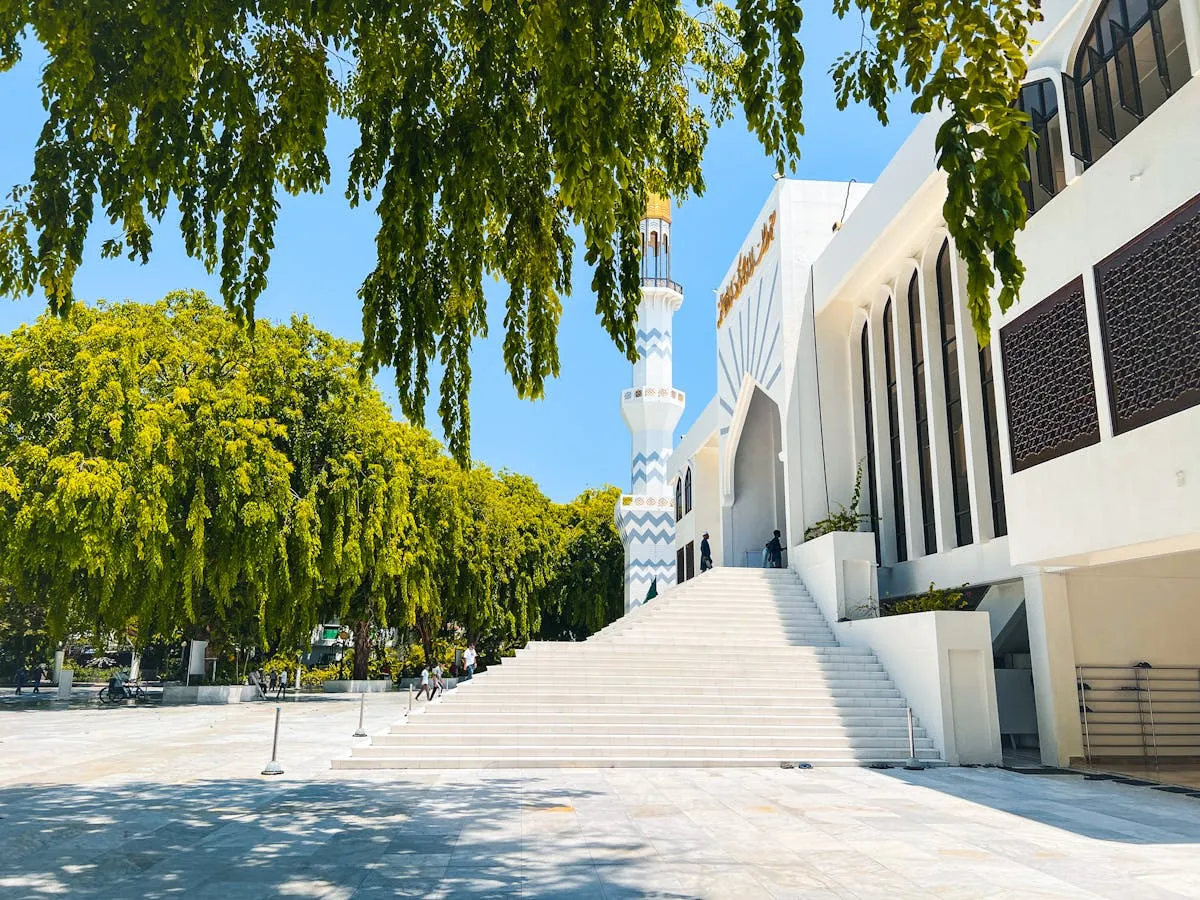
Following the conversion, the Maldives became an Islamic sultanate that would endure for over eight centuries. The sultans ruled from Male, which grew into the political and commercial centre of the archipelago. Islam reshaped every aspect of Maldivian life, from law and customs to architecture and art. The ornate coral stone mosques built during the sultanate period, with their intricate calligraphy and carvings, are among the finest examples of Islamic architecture in South Asia.
The sultanate period was not without turbulence. Power struggles between rival factions, invasions by South Indian kingdoms, and internal rebellions punctuated the centuries. Despite this, the Maldives maintained a unusual degree of independence and cultural distinctiveness, developing a unique blend of Islamic practice infused with local traditions that is still visible in festivals and everyday island life.
In 1558, the Portuguese, who had established a powerful maritime empire across the Indian Ocean, conquered the Maldives and killed Sultan Ali VI. For fifteen years, from 1558 to 1573, the islands endured Portuguese occupation. The Portuguese attempted to convert the population to Christianity and imposed harsh rule from their garrison in Male. This period is remembered in the Maldives as a time of oppression and cultural assault.
Resistance to the Portuguese was led by Muhammad Thakurufaanu, a warrior from Utheemu island in the far north of the archipelago, who is now regarded as the greatest national hero in Maldivian history. Along with his brothers Ali and Hassan, Thakurufaanu waged a guerrilla campaign, travelling between islands in a sailing vessel and rallying support. In 1573, Thakurufaanu and his followers liberated Male and expelled the Portuguese, restoring the sultanate.
Muhammad Thakurufaanu became sultan and initiated reforms that strengthened the country's defences and administration. His legacy is celebrated on National Day, and his childhood home on Utheemu has been preserved as a museum. The Portuguese occupation, though brief, reinforced the Maldivian sense of identity and resistance to foreign domination, themes that would resurface during later colonial encounters.
By the late 19th century, European colonial powers were carving up Asia and Africa, and the Maldives found itself drawn into the British sphere of influence. In 1887, the Sultan signed an agreement making the Maldives a British protectorate. Under this arrangement, the Maldives retained internal self-governance while Britain controlled defence and foreign affairs. The British were primarily interested in the strategic location of the islands and later established a military base on Addu Atoll during World War II.
The protectorate period brought gradual changes to the Maldives. British influence introduced new administrative practices, and the presence of the Royal Air Force base on Gan island in Addu Atoll from the 1950s onward created employment and exposed southern Maldivians to Western lifestyles. However, the protectorate also created tensions, most dramatically in the short-lived secessionist movement in the southern atolls in the late 1950s and early 1960s, which declared an independent United Suvadive Republic before being reabsorbed into the Maldivian state.
Throughout the protectorate period, Maldivian sultans continued to govern domestic affairs, and the essential character of island community life remained largely unchanged. The British presence was light, and most Maldivians in the central and northern atolls had little direct contact with colonial administrators.
The Maldives gained full independence from Britain on 26 July 1965, a date celebrated each year as Independence Day. Three years later, in 1968, a national referendum abolished the sultanate and established the Republic of Maldives. Ibrahim Nasir, who had served as prime minister, became the first president of the republic.
The modern era of the Maldives is largely defined by the arrival of tourism. The first tourist resort opened in 1972 on Kurumba island, near Male, marking the beginning of an industry that would transform the Maldivian economy. Within decades, tourism surpassed fishing as the primary source of national income, and the Maldives became one of the world's most sought-after luxury holiday destinations. The tourism model, which allocates entire islands to individual resorts, has shaped the country's development in profound ways.
Maumoon Abdul Gayoom, who assumed the presidency in 1978, led the country for thirty years, overseeing rapid modernisation, the expansion of tourism, and significant improvements in education and healthcare. His tenure also saw the Maldives emerge as a vocal advocate on the world stage for action against climate change, given the existential threat rising sea levels pose to this low-lying nation. The 2004 Indian Ocean tsunami, which devastated many islands, underscored this vulnerability.
In 2008, the Maldives held its first multi-party democratic elections, won by Mohamed Nasheed. The transition to democracy, the growing importance of environmental stewardship, and the ongoing challenge of balancing modernisation with tradition continue to define the Maldives in the 21st century. Today, the archipelago navigates between its ancient heritage and a rapidly changing world, its history reflects the resilience of a small island nation.