 Maldives Compass
The Iconic Hammerhead
Of all the shark species you might encounter in the Maldives, the scalloped hammerhead is arguably the most thrilling. With its wide, flattened head - known as a cephalofoil - and its tendency to gather in large schools at depth, the hammerhead represents a bucket-list sighting for divers around the world. The Maldives is one of a handful of destinations where these encounters are genuinely possible, and for many visitors, a hammerhead dive is the single most memorable moment of their trip.
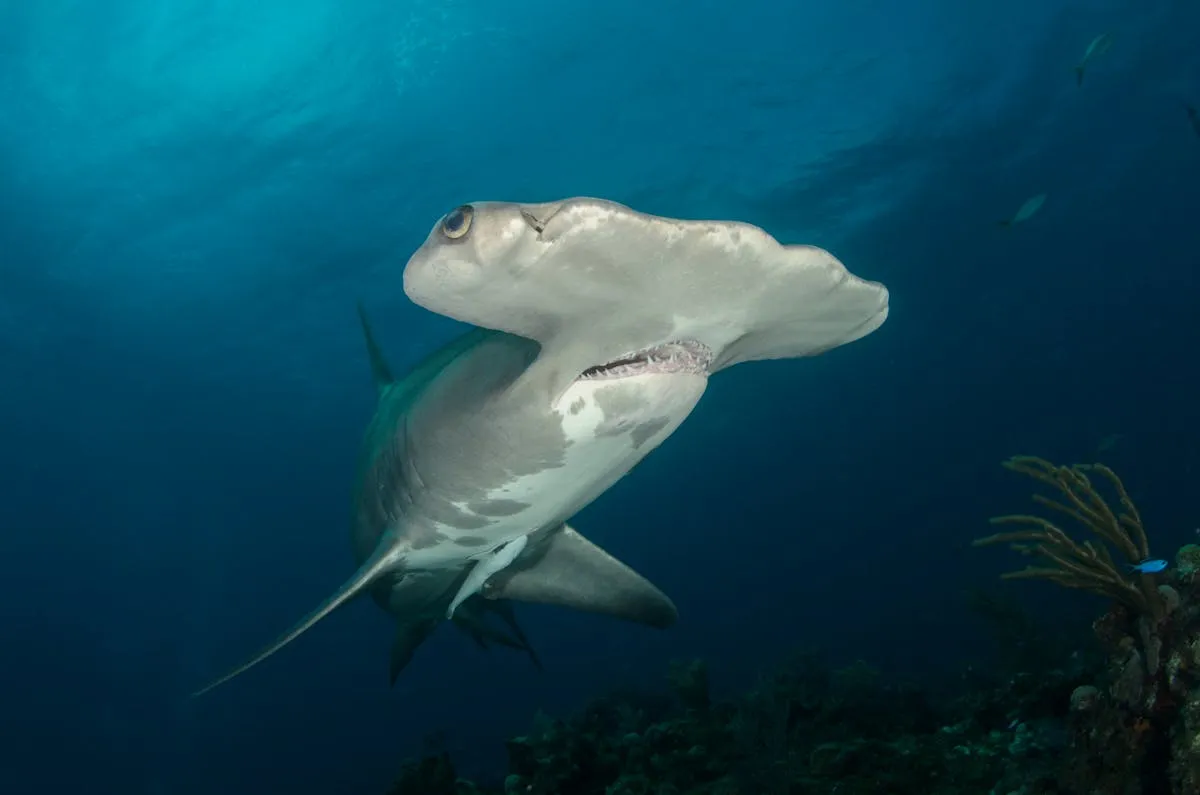
The species found in Maldivian waters is the scalloped hammerhead (Sphyrna lewini), named for the scalloped indentations along the front edge of its head. Adults can reach up to three metres in length, though most individuals seen on dives are somewhat smaller. Their unique head shape is not just a curiosity - it is a highly evolved sensory organ packed with electroreceptors that allow hammerheads to detect the faint electrical fields produced by prey hiding beneath the sand.
Why That Head Shape Matters
The hammerhead's cephalofoil has fascinated marine biologists for decades. The wide spacing of the eyes gives the shark near-360-degree vision in the vertical plane, meaning it can see above and below itself simultaneously. The broad underside of the head is studded with ampullae of Lorenzini - electroreceptive pores that act like a living metal detector, sweeping the seabed for buried stingrays, crustaceans, and small fish.
The head also functions as a hydrodynamic wing, providing lift as the shark swims and allowing it to make incredibly tight turns. Watching a hammerhead bank and pivot underwater is like watching a fighter jet manoeuvre - there is a precision and power to their movement that sets them apart from other shark species. This combination of sensory superiority and agility makes the hammerhead one of the ocean's most effective predators.
Where to See Hammerheads
The most famous hammerhead dive site in the Maldives is Hammerhead Point at Rasdhoo Atoll, a small atoll on the eastern edge of Ari Atoll. Here, scalloped hammerheads gather in schools along the outer reef slope, typically at depths of 25 to 40 metres or more. The dive involves descending to the reef edge in the pre-dawn darkness and waiting on a sandy slope as the first light of day begins to filter through the water. As visibility improves, the silhouettes of hammerheads appear - sometimes just a few individuals, sometimes schools of twenty or more gliding through the blue.
Other reliable hammerhead sites include the outer channels of South Ari Atoll, certain sites in Vaavu Atoll, and deep thilas in North Male Atoll. Liveaboard dive boats that travel southern routes occasionally encounter hammerheads at Huvadhoo Atoll and Addu Atoll as well. In general, the deeper and more current-exposed a site is, the better the chances of hammerhead encounters.
Early-Morning Dives
Hammerhead dives in the Maldives almost always take place at dawn. The boats typically depart around 5:30 AM, with divers entering the water as the sky is just beginning to lighten. There is a good reason for this: hammerheads spend the night hunting in deeper open water and return to the reef slopes at dawn to rest and be cleaned by smaller fish. As the morning progresses and the sun climbs higher, the schools tend to descend to greater depths or disperse.
These early starts can be tough, especially after a late night on a liveaboard, but the reward is worth it. The atmosphere of a hammerhead dive is unlike any other - the darkness, the depth, the anticipation, and then the sudden appearance of those unmistakable shapes. Even experienced divers who have logged thousands of dives describe hammerhead encounters as genuinely awe-inspiring.
Depth and Current Requirements
Hammerhead diving is not for beginners. Most encounters occur at depths between 25 and 40 metres, with some requiring descents beyond recreational limits. Strong currents are common at the channel and reef-edge sites where hammerheads congregate, and the pre-dawn conditions mean reduced visibility and more challenging navigation. Most dive operators require a minimum of Advanced Open Water certification and at least 50 logged dives before allowing guests on hammerhead-specific trips.
Good buoyancy control is essential. Hammerheads are more skittish than reef sharks, and a diver who crashes into the reef or makes sudden movements will quickly scatter the school. The best approach is to descend to the recommended depth, settle onto the reef edge, and remain as still and quiet as possible. Controlled breathing and minimal movement dramatically increase your chances of a prolonged, close encounter.
Best Season for Hammerheads
Hammerheads can be seen in the Maldives year-round, but sightings peak during the northeast monsoon season, roughly from December through April. During this period, the cooler water temperatures and calmer seas on the eastern sides of the atolls create conditions that hammerheads seem to favour. Rasdhoo Atoll's famous site is most productive between January and March, when schools are largest and most consistent.
The southwest monsoon season from May to November can still produce sightings, but they tend to be less predictable. Water temperatures are slightly warmer, currents shift, and the hammerheads may move to different areas. If hammerhead encounters are a priority for your trip, planning around the northeast monsoon gives you the best odds.
Conservation Status
Scalloped hammerheads are listed as Critically Endangered on the IUCN Red List, making every sighting in the Maldives a privilege and a reminder of what is at stake. Globally, hammerhead populations have declined dramatically due to overfishing, driven largely by the demand for shark fins. Hammerhead fins are among the most valued in the shark fin trade because of their high fin-needle content, which makes them particularly sought after for shark fin soup.
The Maldives' designation as a shark sanctuary since 2010 provides important protection within its waters, but hammerheads are highly migratory and spend much of their lives in international waters where protections are weaker. Conservation efforts in the Maldives focus on monitoring populations, protecting critical habitat like the cleaning stations and aggregation sites that hammerheads depend on, and supporting international agreements to reduce shark finning.
As a diver or visitor, you contribute to hammerhead conservation simply by choosing to see them alive. The economic value of shark tourism in the Maldives far exceeds the value of shark fishing, and every dive trip that seeks out hammerheads reinforces the argument that these animals are worth more alive than dead. For more on sharks across the archipelago, see our Sharks in the Maldives overview and our guide to reef sharks.
Schooling Behaviour
One of the most aspects of scalloped hammerheads is their tendency to form large schools during the day. While many shark species are solitary, scalloped hammerheads are highly social, and the schools seen at sites like Rasdhoo can number anywhere from a handful to over a hundred individuals. Scientists believe these daytime aggregations serve multiple purposes: they provide protection from larger predators, facilitate social bonding, and may play a role in mating.
Within the schools, there is a clear hierarchy. Larger females tend to occupy the centre of the formation - the safest position - while smaller individuals and males patrol the edges. The schools move with a fluid, almost hypnotic rhythm, with individual sharks constantly adjusting their position relative to their neighbours. At night, the schools break apart and individuals head into deeper water to hunt alone, reuniting at the reef slope the following dawn.
Why the Maldives Is Special
The Maldives occupies a unique position in the Indian Ocean - a chain of atolls sitting atop an underwater mountain ridge that creates upwellings of nutrient-rich water. These nutrients support a rich food chain from plankton up to top predators, and the numerous channels between atolls create the current-swept environments that hammerheads prefer. Combined with the shark sanctuary protections and a well-developed diving infrastructure, the Maldives offers one of the most accessible and reliable hammerhead experiences anywhere in the world.
Other famous hammerhead destinations like Cocos Island, the Galapagos, and Layang-Layang require long, expensive journeys to remote locations. The Maldives, by contrast, places world-class hammerhead diving within reach of a relatively straightforward holiday. Whether you join a liveaboard cruise through Ari Atoll or base yourself at a dive resort near Rasdhoo, the chance to see these impressive, critically endangered sharks in their element is one of the most compelling reasons to visit the Maldives. Pair your hammerhead dives with a visit to South Ari for whale shark encounters, and you will have experienced two of the ocean's most notable animals in a single trip.