 Maldives Compass
Resort Islands vs Local Islands
A detailed comparison of costs, experiences, and practicalities to help you decide.
One island, one resort - the concept that turned the Maldives into the world's most exclusive tropical destination.
The Maldives pioneered a model of tourism that is unique in the world: each resort occupies its own island. There are no shared beaches, no neighbouring hotels, and no public access. When you stay at a Maldivian resort, the island is effectively yours - shared only with other guests and the staff who keep everything running.
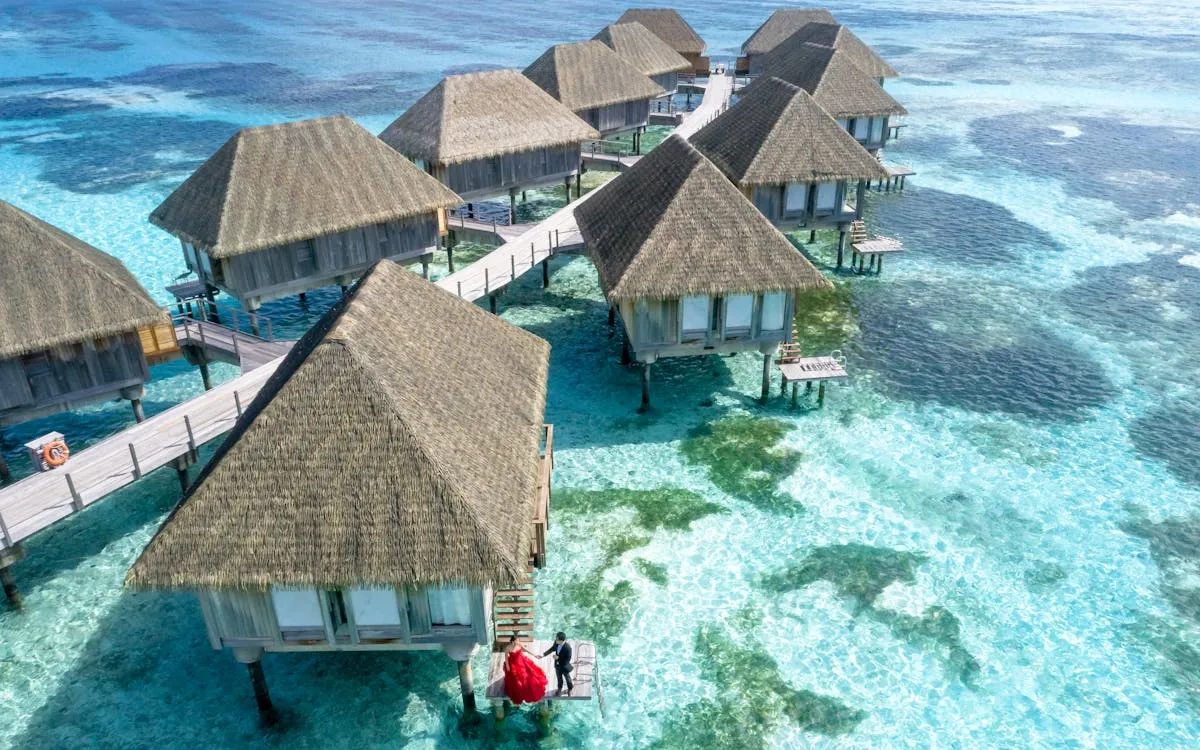
This model was not an accident. When tourism began in the Maldives in 1972, the government deliberately separated resort development from inhabited islands. The idea was to protect Maldivian communities and cultural traditions from the disruptions that mass tourism could bring, while still capturing the economic benefits of a growing industry. It worked. The model created an entire category of luxury hospitality and gave the Maldives a brand identity recognised worldwide.
Resort operators lease uninhabited islands from the Maldivian government on long-term agreements, typically for 25 to 50 years. They develop the island from scratch - building villas, restaurants, jetties, desalination plants, power generation, and waste management facilities. Each island becomes a self-contained world, independent of the infrastructure on inhabited islands.
This means every resort has a different character, shaped by the island it occupies. Some sit on large islands with dense vegetation and long beaches. Others are tiny - small enough to walk around in ten minutes. Some have vast, shallow lagoons ideal for snorkelling directly from the beach. Others are positioned on the outer reef edge, with dramatic drop-offs and strong currents just offshore that attract larger marine life.
Arriving at a private island resort typically begins at Velana International Airport in Malé, where the resort's team meets you and arranges the onward transfer. Depending on the island's location, this might be a 20-minute speedboat ride or a scenic 45-minute seaplane flight over the atolls. Some of the more remote resorts require a domestic flight followed by a boat transfer.
Once on the island, the experience is designed around a single principle: you should not need to leave. Resorts offer multiple restaurants (often specialising in different cuisines), bars, swimming pools, spas, water sports centres, diving schools, fitness facilities, and curated excursion programmes. Higher-end properties add features like overwater villas with glass floors, private pools, personal butler service, underwater restaurants, and even private cinema screenings.
The house reef is often the centrepiece of the natural experience. Many resorts are surrounded by healthy coral reefs that you can snorkel directly from the beach or the jetty. Reef fish, sea turtles, small sharks, and rays are common sights. Resorts with particularly good house reefs are a major draw for snorkellers and divers alike.
Not all private island resorts are ultra-luxury. The Maldives has resorts across a broad price range, from high-end international brands to more affordable four-star properties. While the entry cost is still higher than a local island guesthouse, the variety means there are options for different budgets.
At the top end, resorts like those operated by Soneva, One&Only, Waldorf Astoria, and St. Regis set global benchmarks for luxury hospitality. Nightly rates at these properties can exceed $2,000 to $5,000, and they attract a clientele that expects perfection in every detail.
In the mid-range, brands like Adaaran, Bandos, and Summer Island offer solid resort experiences at lower price points - sometimes under $300 per night. These properties may have simpler rooms and fewer dining options, but they still deliver the core private island experience: your own beach, a house reef, and the notable Maldivian setting.
The private island model has clear advantages - privacy, exclusivity, and smooth service. But it also comes with some trade-offs worth knowing about.
Isolation. You are on a small island, often far from anything else. If you want variety, local culture, or the freedom to wander, you may find a resort island limiting after a few days. Some travellers love the seclusion; others find it repetitive.
Cost. Beyond the room rate, resort pricing for food, drinks, and excursions is typically very high. A beer might cost $10 to $15, a dinner $50 to $150 per person, and a diving excursion $100 or more. All-inclusive packages help control costs but are themselves expensive. For a detailed comparison, see resort islands vs local islands.
Environmental impact. Building and operating a self-contained resort on a small coral island has environmental costs - energy use, desalination, waste, and reef disturbance. Many resorts now invest in sustainability programmes, coral restoration, and marine protection. Some do this genuinely and effectively; others less so. If environmental responsibility matters to you, it is worth researching a resort's practices before booking.
You do not have to choose one or the other for your entire trip. A popular approach is to split time between a local island and a resort island, getting the cultural experience and the luxury experience in one visit. Island hopping makes this easy to arrange, and many travellers find the contrast between the two styles makes each one more enjoyable.