 Maldives Compass
Resort Islands vs Local Islands
Understand the two main types of visitor experience and which might suit your trip.
A country built on coral - how atolls, reefs, and lagoons create one of the most unusual geographies on Earth.
The word "atoll" comes from the Dhivehi word atholhu, and the Maldives is where the concept was first described. An atoll is a ring-shaped coral reef formation that encloses a shallow lagoon. From above, each one looks like a rough oval or circle of reef with islands dotted along its rim and calm, turquoise water in the middle.
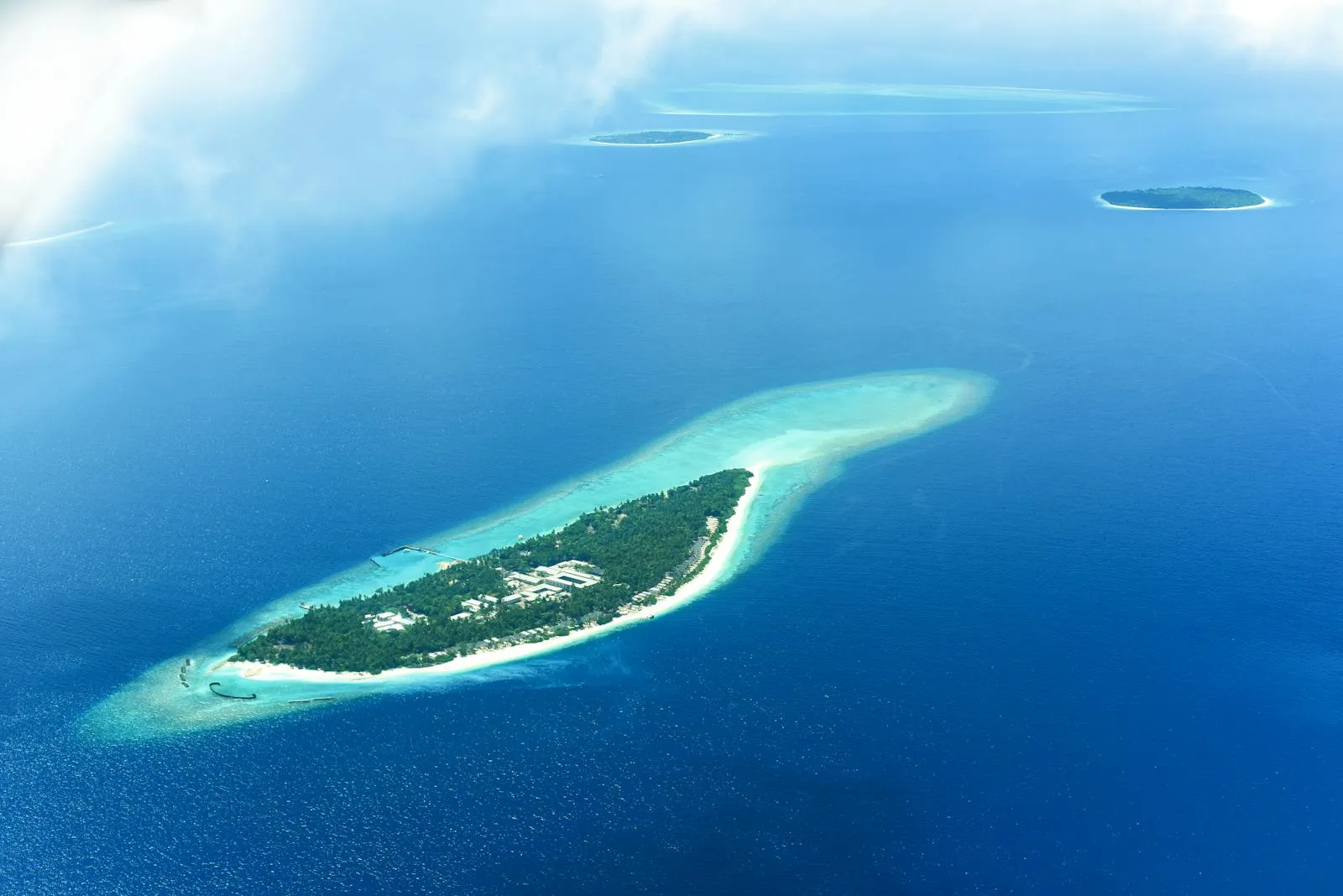
The Maldives has 26 natural atolls, which together form a double chain running roughly north to south through the Indian Ocean. These atolls vary hugely in size. Some contain just a handful of islands, while others hold dozens. The entire chain stretches about 870 kilometres, yet the total land area of all islands combined is only around 300 square kilometres - roughly the size of a mid-sized city.
Maldivian atolls are coral formations built over millions of years. The process begins with a volcanic island that slowly sinks back into the ocean floor. As it sinks, coral continues to grow upward around its edges, maintaining contact with the sunlit surface waters it needs to survive. Eventually the volcano disappears entirely, leaving behind a ring of living coral reef with a lagoon where the volcanic peak once stood.
This means every island in the Maldives is made of coral, not rock. The white sand on the beaches is ground-up coral and shell, processed over time by waves and by parrotfish, which bite off chunks of reef and excrete them as fine sand. The entire country is, quite literally, a biological creation.
Within each atoll, individual islands form where sand and coral debris accumulate on the reef. These islands tend to be very small and very flat. The average island in the Maldives rises no more than about 1.5 metres above sea level, and the highest natural point in the entire country is only around 2.4 metres. Many islands are just a few hundred metres across.
Islands are not permanent fixtures. They shift, erode, and rebuild with the currents, monsoon patterns, and changes in reef health. Some islands grow over time as new sand accumulates. Others shrink or move position. A few have disappeared entirely, while new sandbanks occasionally emerge from the water.
Of the roughly 1,200 islands, about 200 are home to local Maldivian communities. These inhabited islands have mosques, schools, harbours, and island councils. They range from tiny communities of a few hundred people to the densely packed capital city of Malé, where more than 200,000 people live on just over five square kilometres.
Around 160 islands operate as resort islands, each typically occupied by a single hotel or resort. The remaining islands - the majority - are uninhabited. Some are used for farming or industry, but many are simply left as they are: small, wild patches of sand and vegetation in the middle of the ocean.
For governance purposes, the 26 natural atolls are organised into 20 administrative divisions, each identified by a letter of the Thaana script (the writing system used for Dhivehi). Each inhabited island has its own island council, elected by the local community, which manages day-to-day affairs. Atoll councils coordinate across islands within their division.
This system reflects the practical reality of governing a nation where communities are spread across hundreds of kilometres of ocean. Transport between islands depends on boats and, for longer distances, domestic flights and seaplanes - something you can learn more about in the practical section.
Each atoll contains a lagoon - the shallow, sheltered water inside the reef ring. These lagoons are what give the Maldives its iconic turquoise colour, as sunlight passes through clear, shallow water over white sand. The reef itself acts as a natural barrier, breaking ocean swells and creating calm conditions inside.
Between atolls and sometimes within them, deeper channels called kandu allow ocean water to flow in and out. These channels are important for marine life, as nutrient-rich water from the open ocean feeds the reef ecosystem. They are also some of the best spots for diving and snorkelling, where you can encounter manta rays, sharks, and large schools of fish.