 Maldives Compass
What Is the Maldives?
Understand the nation behind the destination - its islands, people, and identity.
From turquoise lagoons to underwater worlds, the Maldives has earned a reputation that few destinations can match.
The first thing most people associate with the Maldives is the colour of the water. The lagoons inside each atoll are shallow, with white sandy bottoms that reflect sunlight upward, creating those vivid shades of turquoise and aquamarine that dominate every photograph. Visibility in the open water regularly exceeds 30 metres, making it some of the clearest ocean water anywhere in the tropics. This clarity is partly a result of the remote oceanic location - there are no rivers carrying sediment into the sea, and the coral sand is naturally fine and white.
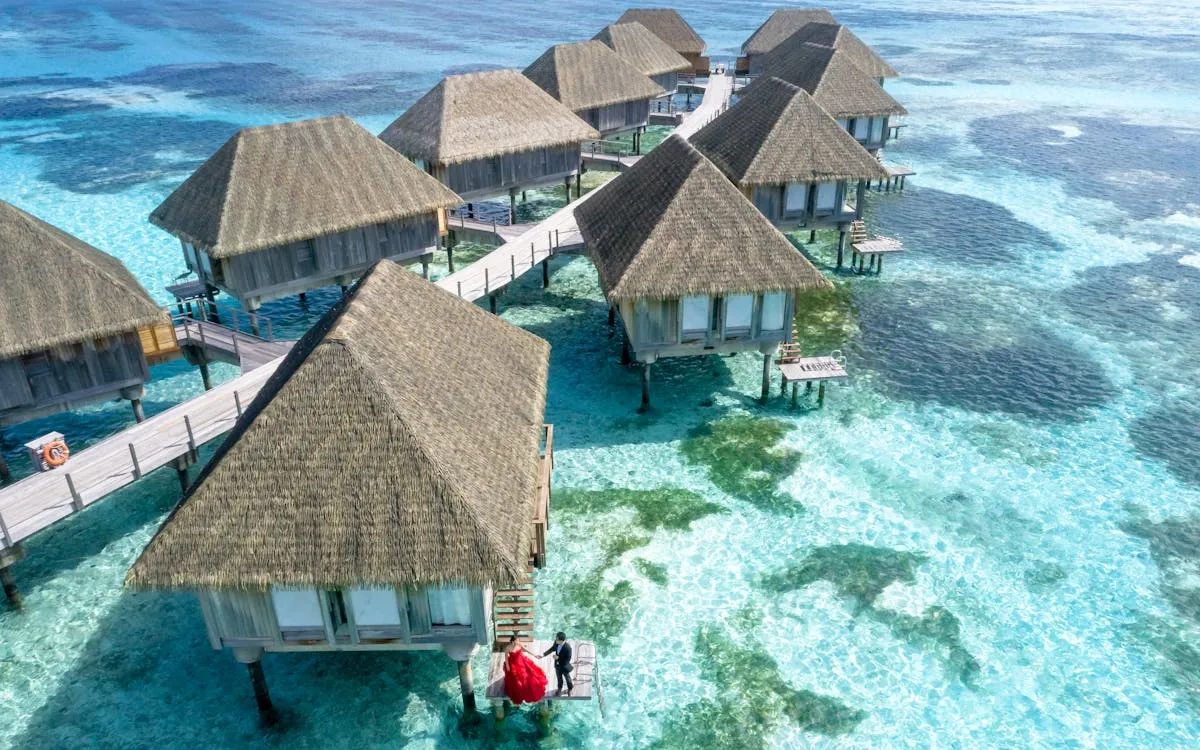
The Maldives did not invent the overwater villa - that distinction belongs to French Polynesia - but it has arguably perfected the concept. Today, the image of a thatched-roof bungalow perched on stilts above a turquoise lagoon is practically synonymous with the Maldives. Dozens of resort islands offer these villas, many with glass floor panels, private infinity pools, and direct ladder access to the reef below. The overwater villa has become a symbol of tropical luxury worldwide, and the Maldives remains the single most popular destination to experience one.
The Maldives sits at the heart of one of the richest marine ecosystems in the Indian Ocean. Its coral reefs support over 2,000 species of fish, more than 200 species of coral, and cast of larger marine life. Manta rays gather at cleaning stations in several atolls, whale sharks cruise through nutrient-rich channels, sea turtles nest on quiet beaches, and dolphins ride the bow waves of dhoni boats at sunset.
For snorkellers and divers, the Maldives offers easy access to this underwater world. Many house reefs sit just metres from the shore, meaning you can wade in from the beach and find yourself surrounded by reef fish, moray eels, and coral gardens within minutes. Deeper channel dives offer encounters with sharks, eagle rays, and large schools of pelagic fish.
The Maldives has positioned itself as one of the premier luxury destinations on the planet. Nearly every major international hotel brand operates at least one resort here, and competition among properties has driven a level of innovation and opulence that is hard to find elsewhere. Underwater restaurants, floating breakfast trays, private island buyouts, underwater spas, and personal butler service are common offerings rather than outliers.
This reputation for luxury has made the Maldives a favourite for honeymoons, milestone celebrations, and high-profile getaways. However, the country also offers budget-friendly guesthouse stays on local islands, making it more accessible than its luxury image might suggest.
The Maldives is famous simply for what it is - a country made entirely of coral, barely rising above the waves, scattered across a vast stretch of ocean. The concept of islands so flat that you can see from one coast to the other, surrounded by reef and deep blue sea in every direction, captures the imagination. It is a landscape that feels both impossibly fragile and breathtakingly beautiful.
The geography also contributes to the country's fame in a more sobering way. As the lowest-lying nation on Earth, the Maldives has become a global symbol of the threat posed by rising sea levels and climate change. This has kept the country in international headlines and given it a voice on the world stage that far exceeds its small size.
On certain nights, the beaches of the Maldives glow with an ethereal blue light. This phenomenon, caused by bioluminescent phytoplankton (primarily dinoflagellates), occurs when the organisms are disturbed by waves or footsteps, causing them to emit a brief flash of light. While bioluminescence happens in oceans around the world, the Maldives has become one of the most famous places to witness it, particularly along the beaches of Vaadhoo Island and several atolls in the south. The sight of glowing waves lapping against a dark beach has become one of the most shared images of the Maldives on social media.
With no mountains, buildings, or obstructions on the horizon, sunsets in the Maldives are famously unobstructed - the sun simply sinks into the flat line where ocean meets sky. Combined with the privacy and seclusion that island geography naturally provides, this creates an atmosphere of peace and detachment from everyday life that is central to the Maldivian appeal. Many visitors describe the feeling of being on a small island, surrounded by ocean in every direction, as unlike anything else they have experienced.